Entries tagged "“social media”"

How often is business an exercise in stripping? Showing everything, allowing in nothing.

I wrote this as part of a grant application in 2004 I think. Maybe 2005. There’s a phrase in here I come back to again and again to describe what is missing in many situations and what I’m looking to change, the intimacy I want to make and the conditions for it I want us all to make and have:

There’s is a big difference between a strip club and sexual intimacy. I think we’re after the business difference too. How often are pr/ SEC filings, marketing and branding and advertising an exercise in stripping? Even when showing everything, allowing in/exchanging nothing.

Thanks to Tony Comstock for pulling this bit out and inspiring me to think that perhaps it’s worth sharing all of this. I’d love to hear your thoughts.

(one small note: I plan to bring the Heather Gold Show back as subvert with heather gold sometime this year. If you’re interested in working on producing the podcast let me know.)

There is no audience.

Interactive performance
Is one way to describe what I do. Other terms I’ve used include freestyle comedy, story DJ, interactive comedy, and human filter. It’s tough mapping language to experience and feeling.

I use personal storytelling, humour, improvisation, conversation, communal activity and other techniques to create a relatively quick sense of intimacy and connection in the room. In traditional theatre the story is the means. I’m exploring ways to make it the end as well, so that the catharsis is not somewhere over there on stage but inside of everyone in the room. What if the performance were not about someone who is a baker, but is unfolding as I bake with everyone right now?

This entails adapting to the audience and encouraging their participation and energy as a factor in the show. It means spending as much time designing conditions likely to create a live experience as it does scripting. It also means being as genuine and authentically ones self as possible. There are a host of little tricks and techniques I’m learning as this path unfolds. For example, I’ve found that if I “go first” it makes it much easier for others to open up as well. This authenticity means means being imperfect. In public.

The business world more than any other has, sometimes silently and sometimes in memos, asked us to leave our whole selves outside the door and bring only the “efficient” piece of our minds to the task at hand. It takes a whole person, especially the ungraphed and un-Powerpointed parts of our humanity to have fun, to play, to be open. Those things are necessary for real community and creativity to occur.

From The Law Project proposal for my next solo show
Because I write the show by improvising with an audience, I cannot know the threads that will be strongest and remain at the end of the process. My work aims to create live, intimate community by exploring universal subjects that connect us. My interactive plays create community through the performance: To use humour, personal storytelling, and most of all the audience themselves to create a deep sense of connection and inclusion. Unlike most stand-up comics or audience participation shows, I never make comedy at the expense of the audience. I create a space for them to shine.

In Cookie I bake chocolate chip cookies with the audience. In The Law Project I plan to teach law with the audience as I explore my own journey through law school. This will increase the challenge intellectually and emotionally for me as a playwright and performer, as I work to find a way to make the abstract tangible and the theoretical emotionally resonant.
I write by talking / improving and riffing in a long series of workshops that always involve some kind of audience. Cookie was the result of many performances, and I’m interested in creating experiences that challenge folks as well as bring them together.

The commons is shrinking quickly in this nation, with conversations, academic and otherwise, happening more and more between folks who already agree with each other, listening to more of what they already think. Performance (and the law) have the opportunity to strengthen bonds as they can bring folks together who are di”erent, or already in disagreement. “Creating the space” has everything to do with whether or not we’ll truly be able to explore disagreement, or just talk at each other.
I think that the rule of law needs to be seriously examined in a moment in which western cultures believe that it is what makes them unique, better and free . What does rule of law really mean? Is it as powerful as story or is it the arena in which we craft and choose which stories we will collectively live by?

My work builds on the solo performance tradition created by monologist Spalding Gray. Like Josh Kornbluth, who built on Spalding Gray’s work, I use improvisation to create a play that feels alive. But my work focuses on bringing the form to a place that excites today’s audiences. This means building in interactive threads and moments. This means not locking the script completely. This means involving the audience very literally in the show. Video games, then music and now television are all involving interactive elements in part because people are interested in each other. Performance has always been a way of having a unifying collective experience. I’ve been taking elements and principles I learned from a variety of worlds, including the Net and applying them to live performance. And its an ongoing lesson. I try to approach performance like software. I don’t expect it to be completely finished and I know that I will learn something new from the audience every time.

Live performance has an opportunity to do what our Congress, towns and perhaps our real courts are failing to do: Be a public space in we can be whole together. This is theatre as new commons.

From The Heather Gold Show – my live talk show
I don’t force the specific topic of the show but let it grow organically from my lead guest (Thinker/represents light). I believe that passion is a requirement for a meaningful conversation, and that everything is like a wheel: if you can introduce any idea from the hub, then it will connect with any spoke. To curate guests, I choose people who will be able to give very different takes on the same subject, from the Entertainer (represents wine) and Doer (represents bread). These guests are always extremely diverse in terms of background, identity and point of view, but the topic, atmosphere, humour and vulnerability I share and connections I make allow all the guests and audience to come together. This means the show is about living the questions with the guests and everyone there.

From Open Source Management or Live! Corporate! Blogging!
There’s is a big difference between a strip club and sexual intimacy. I think we’re after the business difference too. How often are pr/ SEC filings, marketing and branding and advertising an exercise in stripping? Even when showing everything, allowing in/exchanging nothing.

From Design for Conversation, my business talk/experience
Why do people who make interactive experiences and focus on relationship in their business, have conferences in which the only time people interact is in the halls? How do you design for conversation? What are the qualitative factors in allowing it to happen?

What opens people up? What assumptions am I working from?

• inclusion

• everyone is welcome

• other people are funny

• its great if other folks get laughs too

• story is how we create meaning

• anyone can tell a story in the right conditions

• everyone is interesting when they’re present / authentic

• vulnerability is necessary for connection

• reaching the people on the edge will have an energetic domino effect on everyone else.

I welcome your thoughts and feelings.

Update 4/6/2013 Many thanks to BoingBoing for linking to this post in connection with the production of my interactive show “I Look Like An Egg, but I Identify As A Cookie” 4/8 and 4/9/2013 at Shotgun Players in Berkeley. Tickets for that are here. I learned a great deal of this stuff in making “Cookie.” Since I initially wrote this post I’ve done a fair amount of speaking and some workshop teaching and speaking coaching and a podcast related to how to create the conditions for conversation or “tummelling.” If you’re interested the workshop and talks at Google and Web 2.0 and Ignite, you’ll find much of it here. The podcast is called TummelVision and was done with Deb Schultz and Kevin Marks. It’s here.

“I am not my keywords” Life in Perpetual Beta video interview

At the last SXSW I went into the Ladies room at the Four Seasons Hotel with Melissa Pierce and between flushes, recorded one of my favourite interviews ever. She did a fantastic job of editing. I’m delighted to have this as part of her film and project Life In Perpetual Beta, a phrase I coincidentally used years ago in speaking at the first 140 conference about how everyone is learning to be “private and Public” and everyone is a performance artist now.

This interview gets at a lot of the feminist ideas I’m exploring in my new project #WITH.

WITH contd – Hey, social media commentators: It’s about us stupid.

Alex Madrigal, The Atlantic’s tech writer, has a really nice response to Zadie Smith’s critique of both the film Social Network and facebook itself and its meaning.

Madrigal is hitting on the main thing that most social media phobic critiques miss (eg. Jaron LanierGladwell and Sherry Turkle’s upcoming book which I had the chance to respond to at a recent conference at Bard): the technology is made by us. Us people. Our relationship needs and issues exist without and with the technology.So what is it we are going to do about it? Alex Madrigal mentions a need for a kind of “urban planning” to make facebook and social media better. This is like the idea Stowe Boyd had a while back to approach social media like architecture.  Ross Douthat today commented in the New York Times on Madrigal’s Atlantic comment on Zadie Smith’s NY Review of Books piece saying he weighed in on the side of Madrigal’s call for “mastery” of social media rather than avoiding it.


And even if these publications weren’t finally online and blogging they’d still have esteemed writers writing about each other and people would talk to each other about it and hey, that sounds an awful lot like social media and the Internet, only slower.


I disagree entirely with Douthat’s framing of the question or Smith’s that our challenge is about “how to remain human in a social media world.”  Our challenge is how to be connected to our humanity with or without social media.


Ross Douthat and Zadie Smith why are you so sure we have more human-ness before social media rather than after?


Dissociation is easy to come by. I did it with books for years. Does it make that act less real than when it’s done with a screen? You can do it with a drink, a thought, a snort, a fuck. You can check out and not see others or feel your own basic impulse extremely easily. Intellectuals are as good at this as anyone. Whether you got a PhD for your method of checking out or the delirium tremens our need is to fell what it is we really feel and to be able to handle those feeling, thus developing enough as people to be able to handle and see and enjoy what is in others too, including what is different.


I believe the real question we face is: how can we be ourselves and be ourselves together. How can we be WITH each other?


And I believe that social media is part of a major change in our getting closer to this. Because people who have only been able to manage analytically are getting forced to reconnect to the relational and the relational is getting translated into data where the analytical can understand it.

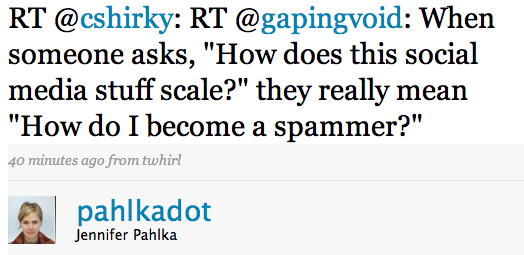
But does it scale?

scalespam1
When people ask me about how I scale intimacy when I’m speaking about How to Tummel (Design for Conversation) what they’re asking is “how can I make money?”

Although I’m showing how intimacy does scale. I’m interested in this unarticulated, but intended question.

When you ask “how can I make money?” before “how can I bring value?” (or it’s seed: “”what delights both me and you?”) then you are building from fear.

My biggest problem with the speech I’ve seen Guy Kawasaki give would-be entrepreneurs “How can I take your money and get it into my pocket,” he says.

Then you’re on a habitraille you can’t get off until you change your very first underlying question. The fear breaks down to an assumption that what matters to me doesn’t matter to you. Therefore I must make stuff that “scales” that everyone will love NOT what makes sense to me. The emotional basis of this is “I can’t be myself and be loved.” That’s what the market is built on…what we create from our assumptions.

It’s just hard to believe that what we love and how we naturally are could be loved by others as well. Solution: day jobs we hate, alcohol and hockey stick graphs on start-up Powerpoints. It either sucks, or it’s a HUGE HIT.

Sustainable, happy living. An honest living (coincidentally the title of my work memoir in progress) is not either or thinking. You can have both. The answer to most either or questions is both. It’s a major mindset shift but once you make it, everything in your life looks different. And social media gives us the opportunity to connect more easily with more people. The barriers to approaching people are much lower. The barriers to being personal and genuine are culturally (and technologically) dissolving. And when you’re authentic, in public the opportunities that come are different. You can be filtered differently and you will filter differently.

You will see others for who they really and and you will be seen and feel seen. You will share what you genuinely care about and you’ll connect with others about the pieces of that that are valued by others too. Social media gives you that opportunity dozens of times a day. That gives you lots of feedback by which to observe the places of genuine intersection.

I want to keep exploring those places. That’s why I involve multiple guests on the Heather Gold Show and involve the whole room. More lines of thought and caring, more possibilities for intersection. Those nodes, they scale in a big way. But they are naturally the creation of many people. That’s how we find them collectively.

I’m not sure what to call them yet, but I’ve got a couple of contenders: truth and love.

New York, NY – 11/05/08

Vote today: Everything I Need to Know About the Web I Learned From Feminism

I proposed this as a panel at SXSW 09. I’m really looking forward to digging into this conversation with some really interesting feminist scholars and web / network thinkers. Voting for the panel happened here. To my surprise the room was packed. It outdrew Larry Lessig’s conversation. I didn’t imagine there would be so much interest and passion about feminism. We had a great conversation with Microsoft researcher/Harvard scholar danah boyd, Wall St Journal reporter and author of a book about MySpace Julia Angwin and Joseph Campbell collaborator and professor Betty Sue Flowers.

There is a really lovely compatibility about the notion of transcendence in both feminism and the Net….both of which give protection and community to those who have been invisible / “private” before.

The Net is quantifying / making visible the value of the social skills / communal skills that have previously gone unvalued by the market or “public” space.

This is inspired, in part, by something else I’m working on: a talk about how I do the performance I do….how to design for conversation rather than presentation all of which changes notions of where authority comes from. This is because the value is relational rather than one-off.

I think it always was..but that aspect was “hidden” by it being a silent piece of “private” life that women mostly carried out….preparing holidays, gatherings..maintaining relationships..creating  and giving physical and other bits of acknowledgement (gifts , cards ..the Christmas newsletter etc) and of course the “salon” which has been a big piece of the basis of how I’ve mashed up a new kind of performance.

There are quite a few ideas embedded in here and for the mag piece..perhaps best to focus on the social networking piece..but that’s just the latest business surfacing of something much deeper..which is the way the West is turning more relational this way…that’s my instinct.

It’s just too costly to market / force awareness of onesself/business without a network effect and any lasting audience/network  can only happen through what is community and community can only be maintained by this “female” stuff.

I found it very interesting in India where these social roles and conventions are still so deeply a part of peoples’ daily lives. I had an unusually deep experience of it myself because of the Niagara Falls shtetl in which I was raised.

I’m excited to see the value of this feminist stuff (as well as performance stuff) in the business arena…though I’m aware that I’m really out on the front edge of explaining and doing much of it..the social media consulting world and facebook shows this stuff to be shifting.

Note: I’ve further developed some of these ideas into a project called #WITH.


Copyright © 1998-2013 Heather Gold. Everything I made is licensed under Creative Commons nc

RSS Feed. This blog is proudly powered by Wordpress and uses Modern Clix, a theme by Rodrigo Galindez.